Sunday, March 18, 2012

Who needs a major record label anymore?


           We, as music lovers, are riding a very interesting era in which artists no longer need the means of major record label.  The internet cut out the middle man and artist seem to prefer the creative autonomy available with independent labels.  The past few years have seen the rise in popularity and critical acclaim of many quality acts that have no association with major record labels.  When you compare that to the complete and utter dependency artists had on major labels for the past 75 years in popular music, it is pretty astonishing. 
              Since there is such a diverse influx of artists out there, not under the pressure of charting on the radio and pushing records down the public’s throat, I feel the need to mention a couple that have done a particularly fine job controlling and distributing their music without the help of the majors.  All these songs have come out in the past year which also is a testament of how the times, they really are a changin’…
First off I will start off with the very appropriate and always awesome Radiohead.  This is their new single off of The King of Limbs.


Another really popular yet also independent group, the one and only The Black Keys.


These guys are super talented and up and coming, also from Seattle which is pretty cool.


This guy is the man.  Building a buzz around his music and is totally authentic.


Local band from Tally…


Indie Culture and the the Internet


                   The idea of being indie has been around for a long time.  Its roots date back to the proto-punk greats of the 60’s and 70’s including The Velvet Underground and The Stooges, followed by many sub-genres that could take a whole day to explain.  There is much to say about the ambiguity over what it really means to be indie but for the sake of simplicity we will define it as an artist who does not belong to a major record label.  There was always an avenue of listeners but the 2000’s saw indie artist rise in popularity.  Thanks to the internet, the distribution and exposure for alternative/indie artists was much easier.  What followed was a much more proud and interactive audience who were actively searching for new and non-mainstream artists.  This phenomenon extends more than music as the internet and e-commerce have reshaped fundamental business models.  It is known as the Long Tail and describes the idea of having a wide dispersion of unique, niche products rather than having a few popular items with a large quantity in stock.  This led to websites and digital downloading programs like iTunes carrying much more independent artists’ music because people were purchasing niche or “indie” music over the internet.  Stores like Wal-Mart saw the rapid decline in CD sells while distributors like Amazon.com experienced an increase in the sale of various underground and alternative artists.  Thanks to the internet, music and the artists themselves are more liberated than ever. 


Thursday, March 15, 2012

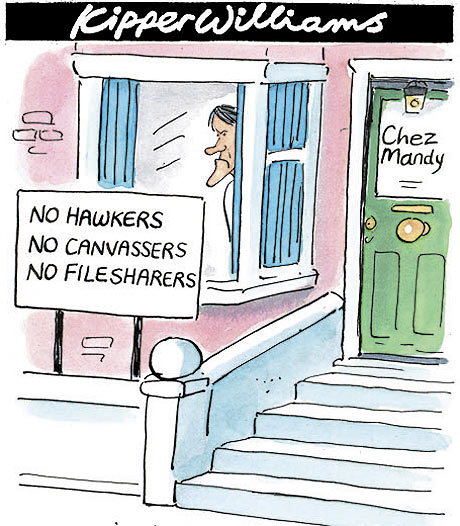
Is file sharing even stealing?


              File sharing crushed the old ways of the music industry and re-shaped the thinking of how to properly distribute music.  I find it humorous that most of the people fighting their best to regulate and control what they call copyright infringement consist mostly of top-tier record labels, music publishers and movie studios; notice not the artists themselves.  The reality is that they’re pissed off about the fact that they can no longer capitalize and monetize on the middle man process in between the creation and the consumption (i.e. artists to fan).  Their argument claims that the unauthorized usage of their intellectually property is copyright infringement and should be viewed as complete and utter theft.  Right there, in the fundamental linings of their defense, exposes how archaic their brick and mortar mindset is of copyright infringement.  Opponents of file-sharing are stuck, lost and left behind in a world of analog, while the digital revolution swallows them whole. 

                You can’t steal something that has unlimited supply, plain and simple.  Think about it, if you went into a hypothetical store of unlimited cookies that never ended and could always be re-generated and you begin to take a handful every time, would this be considered stealing?  You protect something from theft when the availability of the resource is scarce and it has a finite value.  Material goods have a finite value and undoubtedly should be protected by property rights and copyrights.  But the kicker is that music available on the internet or computers are not material goods but rather immaterial goods with an infinite amount of availability.  The minute the physical, sound vibrations of a song are converted into 0’s and 1’s, it loses its material character and should be viewed as infinite.  Copyright expert, Mark Lemley, from Stanford Law describes this point of view accurately stating, "Copyright infringement is not 'theft' in the same way that taking a CD from a store is theft, if I take your physical property, I have it and you no longer do. If I copy your song, I have it, but so do you."
                We should begin to view the file sharing community more as members of society who are partaking in fair use of the music.  The concept of fair use permits the act of copying copyrighted works for academic, artistic, or personal use as long as they don’t monetize the works themselves for their own benefit.
                             Here is a great article that inspired me to think differently about file sharing/pirating

Wednesday, March 14, 2012

How the file sharing/piracy debate is in rainbows…


             So we are now approaching nearly a decade of file sharing and torrent downloading.  The culture and networks supporting this are established and active enough to testify its longevity.  If there were any doubts on the power and infrastructure of the downloading community the backlash and negative publicity over SOPA and PIPA put that to rest… simply stated file sharing, or for the opposition, piracy is here to stay.  But, in relations to music on a macro view, is this intellectual property and copyright infringement a positive reality or destructive to the music industry we all love so dear.  My hope in this entry is to bring enlightenment to the many contemporary ideas concerning copyright infringement and how, whether you like or not, it contains positive qualities.
First off when we as music listeners, or a consumer of anything for that matter, perceives and listens to a given song we have expectations or uses in which we hope to gratify.  We want to receive a benefit from anything like an emotional stimulation, social acceptance, or self expression.  A lot of times these expectations are inherent and satisfied on a sub-conscious level but nonetheless are present.  The minute a monetary exchange takes place, i.e. purchase of a song/album, there is an immediate spike in the music consumers’ expectations.  The money invested psychologically shifts the individual to demand more gratification in order to meet their now raised expectations.  This can ultimately influence the listeners end perception of whether or not you like the artist and if there will be a continuous relationship.  I mean think about the last time you purchased an album (if you can even remember) in which it was sub-par, guaranteed you either forgot about the artist in its entirety or no longer listen to them.  The next time you probably encountered that artists’ you had a very powerful negative stigma going in, which is known as selective process.  This experience brings to light the reality that music listeners are more likely to enjoy, partake, and continue listening to an artist’s when their expectations are lowered.  This happens when they can consume music for free through the usage of file sharing. 
The amount of new music and independent artists that have been able to find success in this realm is very encouraging, especially since most artists are accepting to the communal experience of file sharing more than ever.  To me, the landmark example and one that proved all the positive attributes of file sharing to ring true was the historic release of Radiohead’s In Rainbows.  Already established worldwide in the “indie/alternative” scene, the band decided to release their 7th album completely free via download on their website.  Not to mention also that they did not re-sign to a major label at this period, becoming completely self-distributed.  The album propelled them into a whole new level exposure and critical acclaim.  I will venture to argue that so many people connected strongly to this album because they were able to listen to it with a lowered expectation and sense of gratification due to the absence of monetary exchange.  Ultimately file sharing provides the artists with a much more quality exposure.
Here are the guys from Radiohead on The Colbert Report talking and joking about various issues including self-distribution…http://www.colbertnation.com/the-colbert-report-videos/397946/september-26-2011/radiohead 

Monday, March 12, 2012

Is the music industry a broken record?


We are all connected... whether we like it or not.  The internet rules our conception of what should be considered the norms in society and the dominance of the web culture as a voice is no longer a distant, projected idea but rather a reality.  No industry can testify to this rapid transgression and inherent dependence on the internet more than the music industry.  Referring to what the music industry has experienced roughly over the past 10 years as an identity crisis would be an understatement as virtually every facet from distribution, major/independent labels, artists revenue, marketing and record sales has drastically changed down to its’ core.  But is all this turbulence for the better or should we partake in the nostalgia of a record industry that once was?
The reality is there are a lot of pro’s and con’s to the state of the music industry.  Let’s start off by clarifying and articulating what I consider to be one of the most crucial and fundamental contemporary realities in the music industry, which is that record sales no longer provide the greatest source of revenue.  This would seem like an obvious no brainer to a youthful, tech savvy college kid due to all the streaming and file sharing (check out post on this issue) available at our digital fingertips yet so many people have a hard time processing this fact.  Adaptation is the key to surviving in any industry and members of the music industry need to be able to realize and adjust their models as well.  Since the days of making a few hits and sailing into the “success” sunset are in the distant past we need to re-approach and re-shape our understanding of how music is consumed and how people perceive their relationship with music.  The uses and gratification theory claims that media are actively selected to satisfy our needs.  If our needs are not being satisfied then we will search elsewhere to meet that need and in regards to music, that means listening to other artists.
So is the music industry a broken record?  Far from it, it is just experiencing rapid changes in the digital boom and is, like so many already established industries, trying to keep up.  What artists, record labels and others involved in the music industry need to do is take a more macro approach to the ways in which revenue is streamed as this will bring to light how to satisfy the modern and much different music consumer.  Connection with fans should be seem as the ultimate priority, not because they hopefully will result in monetary benefit, but rather because the fans has 24/7 access to the artist.  What this means is more live shows, more dynamic fan/artists interaction through Facebook/Twitter/Fan page, more merchandise and oh did I mention more live shows!!  From a musical perspective there is no better way to engage fans than with a live show and in the end all these streams of revenue need to come together with one ultimate goal… From an artist’s perspective, that goal is to satisfy their fans’ needs.

Tom Silverman is the founder and the head of TommyBoy Entertainment.  Throughout his career Tom has worked with artists like De La Soul, Digital Underground, House of Pain, Queen Latifah and Afrika Bambaataa.  Check out what he has to say...