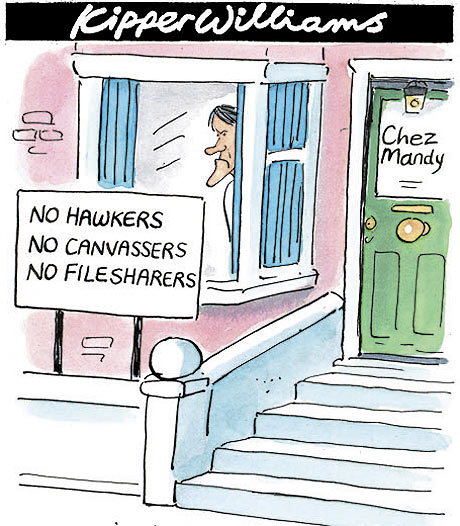
File sharing crushed the old ways of the music industry and re-shaped the thinking of how to properly distribute music. I find it humorous that most of the people fighting their best to regulate and control what they call copyright infringement consist mostly of top-tier record labels, music publishers and movie studios; notice not the artists themselves. The reality is that they’re pissed off about the fact that they can no longer capitalize and monetize on the middle man process in between the creation and the consumption (i.e. artists to fan). Their argument claims that the unauthorized usage of their intellectually property is copyright infringement and should be viewed as complete and utter theft. Right there, in the fundamental linings of their defense, exposes how archaic their brick and mortar mindset is of copyright infringement. Opponents of file-sharing are stuck, lost and left behind in a world of analog, while the digital revolution swallows them whole.
You can’t
steal something that has unlimited supply, plain and simple. Think about it, if you went into a
hypothetical store of unlimited cookies that never ended and could always be
re-generated and you begin to take a handful every time, would this be
considered stealing? You protect
something from theft when the availability of the resource is scarce and it has
a finite value. Material goods have a
finite value and undoubtedly should be protected by property rights and copyrights. But the kicker is that music available on the
internet or computers are not material goods
but rather immaterial goods with an infinite amount of availability. The minute the physical, sound vibrations of
a song are converted into 0’s and 1’s, it loses its material character and
should be viewed as infinite. Copyright expert,
Mark Lemley, from Stanford Law describes this point of view accurately stating,
"Copyright infringement is not
'theft' in the same way that taking a CD from a store is theft, if I take your
physical property, I have it and you no longer do. If I copy your song, I have
it, but so do you."
We should begin to view the file
sharing community more as members of society who are partaking in fair use of the music. The concept of fair use permits the act of
copying copyrighted works for academic, artistic, or personal use as long as
they don’t monetize the works themselves for their own benefit.
Here is a great article
that inspired me to think differently about file sharing/pirating

As college student of course I agree that it isn't stealing. I think the best point for me that you made was that you can't steal something that never runs out. And honestly how are they ever going to be able to stop it? They aren't if anything we are going to get better at "stealing" music.
ReplyDelete